Strategic Planning
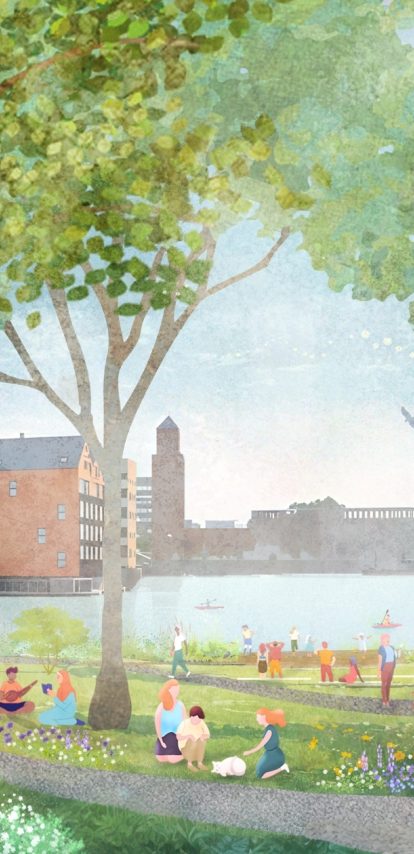
Cities face a growing number of interconnected challenges: climate adaptation, housing demand, mobility transitions, economic development and biodiversity loss. They form one system, and they move together.
Felixx uses Natural Intelligence as the organising framework that brings these agendas together. We identify how natural systems can guide urban development, reveal synergies between competing priorities, and establish spatial frameworks that support long-term resilience.
Working across regional, city-wide and district scales, we help governments and developers translate ecological ambition into coherent strategies for growth and transformation.
Three scales, one framework
Strategic planning works across three scales simultaneously. At the level of the city region, we define the ecological and spatial conditions that shape everything below. At the city scale, we connect natural systems to urban ambitions. And within the urban system, we recognise a set of recurring and critical challenges that demand integrated spatial thinking.

From city-wide strategy
Water as Leverage Cartagena, Colombia

to masterplan

and detailed implementation plan
Three scales, one framework
Strategic planning works across three scales simultaneously. At the level of the city region, we define the ecological and spatial conditions that shape everything below. At the city scale, we connect natural systems to urban ambitions. And within the urban system, we recognise a set of recurring and critical challenges that demand integrated spatial thinking.

From city-wide strategy
Water as Leverage Cartagena, Colombia

to masterplan

and detailed implementation plan
Five crucial challenges in the urban system
Historic city structures. Historic layers are a starting point. We reinterpret existing spatial structures and connect their depth and logic to future challenges, making them resilient and relevant for the next century.
Vital infrastructure. Mobility infrastructure occupies enormous amounts of urban space. By programming it multifunctionally and driving the mobility transition, we free up space for green, water, and people.
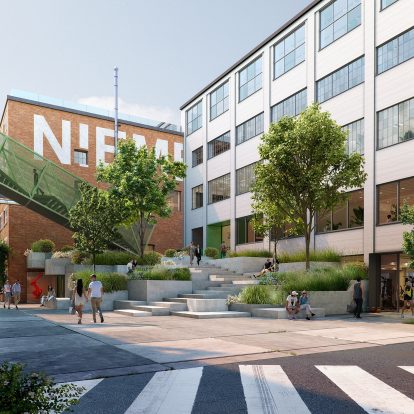
Brownfields. Former industrial sites carry ecological debt and spatial opportunity in equal measure. We make remediation the foundation for ecologically valuable and socially useful urban landscapes.
Densification and mix. As programmatic pressure on the existing city grows, so does the need for complex, integral landscapes where the boundary between building and landscape dissolves. Done well, densification creates opportunity.
Campuses. Where education, culture, care, work, and living come together is where we design frameworks that activate synergy between different urban programmes. Public space forms the connective tissue.
Projects


Want to know more?
John de Groot
Associate partner, landscape and urban designer- Location
- Rotterdam
- expertise
- Design & build
- Strategic planning
Other services

Design & Build
We construct public spaces, built landscapes, and green-blue infrastructure as integral parts of climate-resilient cities. We recognise the cultural dimension of the climate challenge and translate technical preconditions into spatial opportunities that strengthen both place and community.

Policy Advice
We take responsibility for embedding Natural Intelligence into the frameworks that shape cities. We hold positions as city architects, supervisors, and quality team members, instead of advising from the sidelines. From those roles, we integrate climate, water, and biodiversity into spatial frameworks before projects are defined, and translate ecological ambition into guidelines and principles that govern how cities develop.

Research by Design
We study Natural Intelligence, its organisational structures, and the building blocks needed to shape them. We research impact and spatial meaning. From that dual understanding, we identify new and better interventions to develop city regions.