Nature-based Solutions Catalogue
Rooting cities back into their natural systems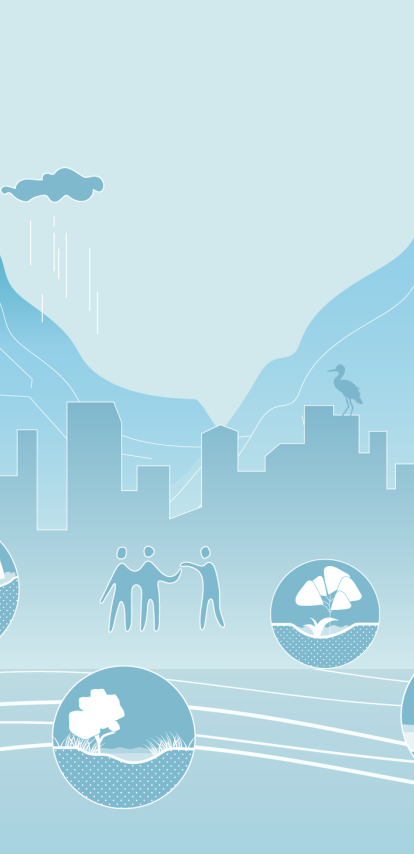
The Catalogue of Nature-based Solutions for Urban Resilience gives the people who plan, finance and build cities a way to choose nature as infrastructure. Felixx developed it for the World Bank Group and GFDRR, and it launched at COP26 in Glasgow in November 2021. Fourteen families of Nature-based Solutions, from green roofs to mangrove forests, each assessed on what it does, where it works, what it costs and what it returns — and a method for deciding which ones a city needs. lives.
Key info
- Year
- 2020 - 2021
- Type
- Infrastructure, Publication, Research
- Client
- World Bank Group
- GFDRR - Global Facility for Disaster Reduction and Recovery
- Status
- Study
The gap between demand and knowledge
Cities grow, and the natural systems that once absorbed their climate stress shrink as they do. Green space contracts, biodiversity declines, and floods, heatwaves and drought arrive with less in their way, at heavy cost to infrastructure, economies and lives.
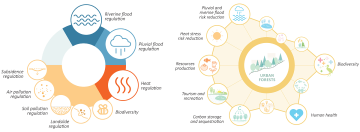
Nature-based Solutions restore that capacity. They are the instruments of Natural Intelligence: the working parts through which a city puts natural processes back to work, delivering infrastructure, services and resilience at urban scale. A well-designed intervention reduces flood risk, restores biodiversity, improves public health, supports food security and strengthens community wellbeing at the same time.
Demand for them is rising faster than the knowledge to act on it. Many of the people responsible for urban resilience decisions have little guidance on when Nature-based Solutions work, what they cost and how to finance them. The catalogue was made to close that gap.
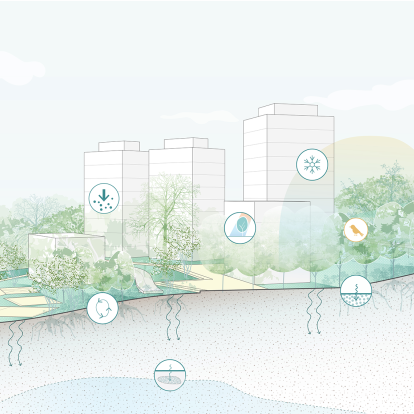
First, locate the city
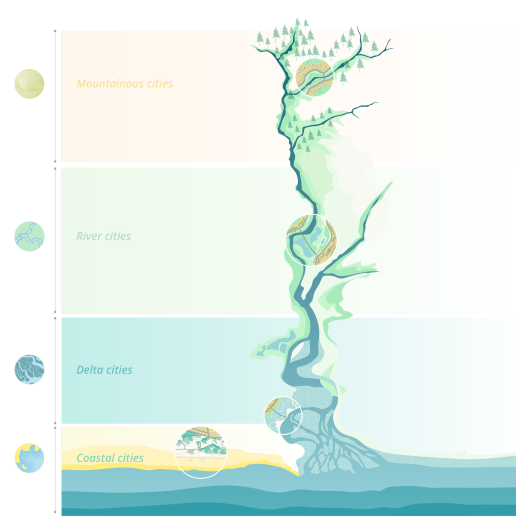
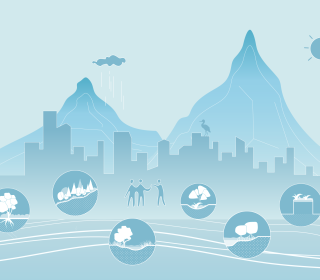
Which solutions a city needs depends on where it sits in its natural system. The water system defines that position, with the climate it sits in. A coastal city, a delta city, a river city and a mountain city each face the water differently, and each needs a different set of tools to root back into the landscape it was built on.
The catalogue starts there. Before it offers a single solution, it asks how water arrives, moves through and leaves a city, and what the natural landscape around it once did with that water. The families that fit follow from the answer.
Three scales, one landscape
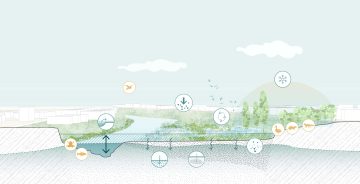
Nature-based Solutions work at three scales. Green roofs and bioswales in a neighbourhood. Urban forests and wetlands across a city. Mangroves and river floodplains sheltering a whole region. The catalogue shows how the three connect and how each depends on the others. A neighbourhood measure performs because the city-scale system behind it works. The city system holds because the regional landscape carries it.
That is where the added value sits. Green and blue patches, scattered, stay patches. Linked across the three scales into strategies and frameworks, they become a landscape again, and nature extends back into the city through them. The method in one line: locate the city within its natural system, find how its neighbourhood spaces and city realms can become part of the regional landscape, and apply the families of Nature-based Solutions to do so.

NBS at the river basin scale

NBS at the city scale

NBS at the neighbourhood scale
Three scales, one landscape
Nature-based Solutions work at three scales. Green roofs and bioswales in a neighbourhood. Urban forests and wetlands across a city. Mangroves and river floodplains sheltering a whole region. The catalogue shows how the three connect and how each depends on the others. A neighbourhood measure performs because the city-scale system behind it works. The city system holds because the regional landscape carries it.
That is where the added value sits. Green and blue patches, scattered, stay patches. Linked across the three scales into strategies and frameworks, they become a landscape again, and nature extends back into the city through them. The method in one line: locate the city within its natural system, find how its neighbourhood spaces and city realms can become part of the regional landscape, and apply the families of Nature-based Solutions to do so.

NBS at the river basin scale

NBS at the city scale

NBS at the neighbourhood scale
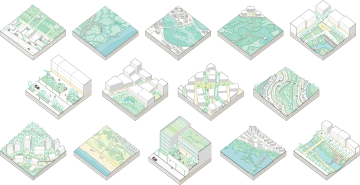
Fourteen families, one framework
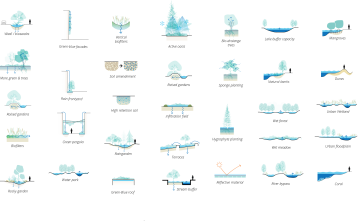
Felixx organised the solutions into fourteen families: urban forests, terraces and slopes, river and stream renaturation, building solutions, open green spaces, green corridors, urban farming, bioretention areas, natural inland wetlands, constructed inland wetlands, river floodplains, mangrove forests, salt marshes and sandy shores.
Every family is assessed on the same five criteria, in the same order. Processes: the natural mechanisms it activates — infiltration, cooling, carbon sequestration. Functions: its measured capacity to regulate a hazard. Benefits: the social, economic and environmental gains it delivers alongside. Suitability: the environmental, technical and urban conditions it needs, with implementation and maintenance costs. Practice: built examples from around the world, with what they taught about the social, financial and governance side.
From protection to value
A sea wall is a cost. A mangrove forest that does the same job is also a fishery, a carbon store, a filter and a shoreline people visit. The catalogue is built to make that difference count.
Every family pairs the hazard it regulates with the benefits it delivers alongside, so a flood measure can be read as an urban investment with several returns. The suitability data cover what each solution costs to implement and to maintain, and the case studies record how built projects were financed and governed. Rebel's financial analysis puts those figures on a comparable footing across all fourteen families.
That is what makes the catalogue usable by the people who hold the budgets. It gives a planner the same kind of information for a wetland that an engineer has for a culvert: what it costs, what it protects, and what else it yields. The World Bank describes Nature-based Solutions as a viable and cost-effective alternative to conventional grey infrastructure. The catalogue is where that claim becomes checkable, family by family.
Instead of scaling up our fights against natural forces, we need to fundamentally shift towards collaboration with nature's power.
Built around the decision
The catalogue is structured the way investment decisions are made. What is the context? What will this deliver? What does implementation require? What can be learned from projects already built? Each family answers those four questions in turn, so the tool works at the desk of a planner, a project developer and a financier alike.
That moves Nature-based Solutions from policy dialogue into spatial planning, project development and financial structuring. Resilience becomes investable. Nature becomes infrastructure.
Working together
Felixx led the catalogue for the World Bank Group and the Global Facility for Disaster Reduction and Recovery, under GFDRR's Global Program on Nature-based Solutions for Climate Resilience and its City Resilience Program. Nelen & Schuurmans brought the hydrology, UNStudio the urban design, Rebel the financial analysis and UNSense the spatial research and data. Together they produced one tool that works across disciplines, geographies and governance systems.
Want to learn more?

Eduardo Marín Salinas
Associate partner in Spain, landscape architect, biologistEduardo is a landscape architect and biologist. Through his studies at the University of Santiago de Compostela and the Polytechnic University of Catalonia, he combines an academic background in biology, botany and ecology with the applied expertise of a landscape architect. Eduardo is an expert in water and climate change who developed the Nature-based Solutions catalogue for the World Bank on behalf of Felixx. Additionally, he has created various sustainable water strategies, including the renowned Water Square / Benthemplein project in Rotterdam. Eduardo worked at De Urbanisten for seven years and has been a senior researcher at Felixx since early 2019. In 2023, he joined the management team as an associate.
Knowledge Hub
Nature-based Solutions Catalogue
Felixx was commissioned by the World Bank to create a Catalogue of Nature-based Solutions (NBS) for Urban Resilience, addressing various hazards across climates. NBS, also known as landscape-based solutions, utilize principles from landscape ecology, emphasizing ecosystem interconnectedness. They are most effective as cohesive systems, improving water management and mitigating climate impacts. This Catalogue presents practical solutions with descriptions, implementation capacities, and precedents, showcasing state-of-the-art approaches to climate adaptation in urban environments.
More info
- team
- Felixx
- World Bank
- Nelen & Schuurmans
- UNStudio
- Rebel
- UNSense
- photography/visuals
- Felixx
- publications
- A Catalogue of NBS for Urban Resilience - World Bank
- Biind
- Architecten Web
- CG Concept
- Openbareruimte.nu
- Rooilijn


