Urban Food Forest Rijnvliet, Utrecht
The Netherlands' first edible neighbourhood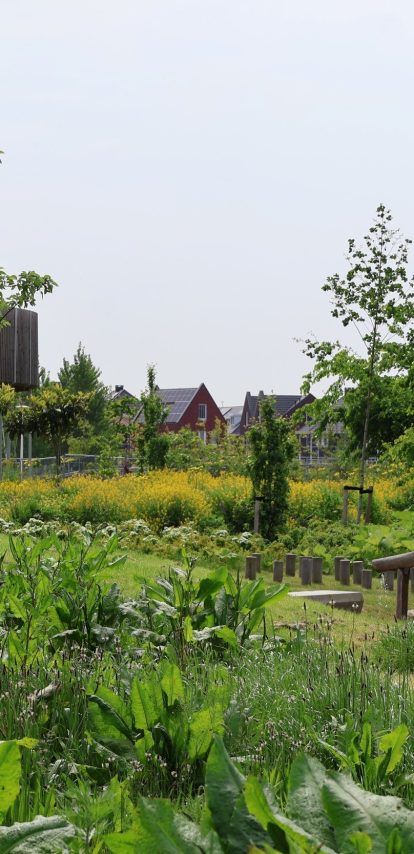
Rijnvliet is a neighbourhood planted as a food forest. Fifteen hectares of Utrecht carry more than a thousand fruit and nut trees and 220 edible species, all of it public space. Every plant feeds someone, human or animal.
The idea came from the future residents, and the Municipality of Utrecht took it up. De Zwarte Hond made the masterplan for a thousand ground-based homes in Leidsche Rijn. Felixx designed the public space inside it, with Æ Food Forestry Development, as the first edible neighbourhood in the Netherlands.
Key info
- Year
- 2017 - 2025
- Type
- Educational, Park, Public Space, Residential
- Size
- 15 ha
- Location
- Utrecht, The Netherlands
- Client
- Gemeente Utrecht
- Status
- Realised
- Awarded
The park carries the neighbourhood
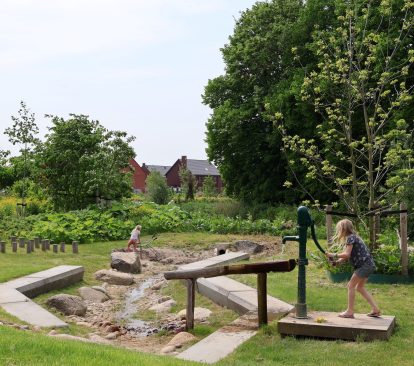
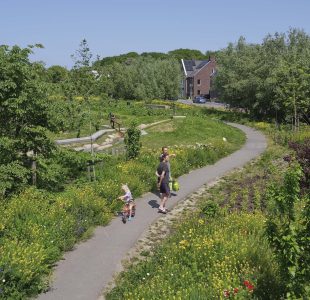
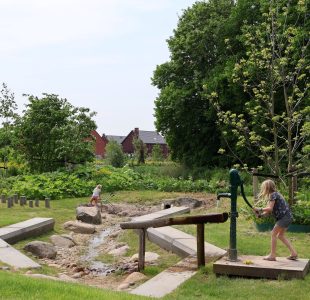
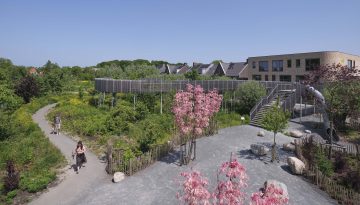
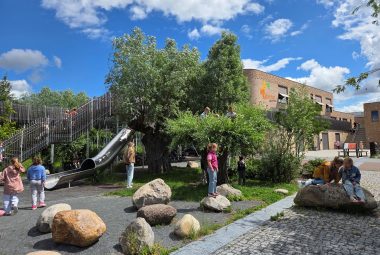
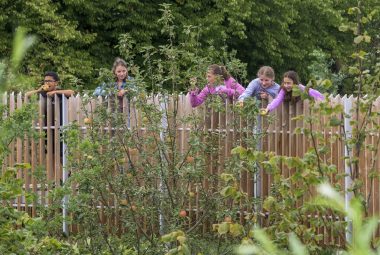
The food forest park is the backbone of Rijnvliet. The public functions sit on it. The school's yard forms part of the park, and a treetop walk carries children from the school into the canopy and across into the park proper. Play spaces and community gardens open off the same central space, so the facilities a neighbourhood shares are gathered in one landscape instead of distributed as separate plots.
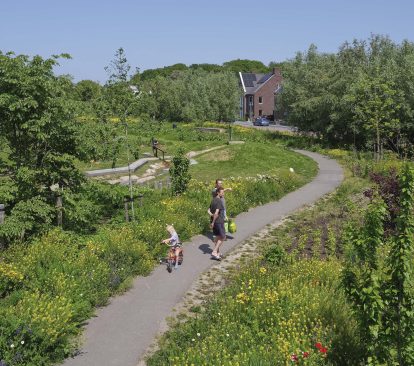
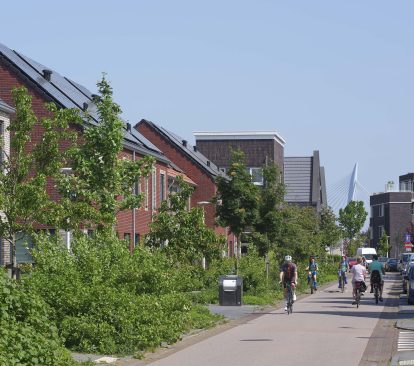
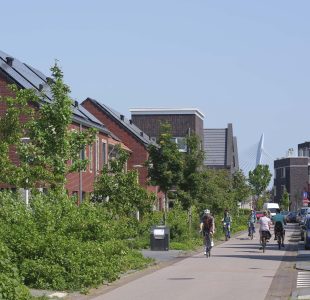
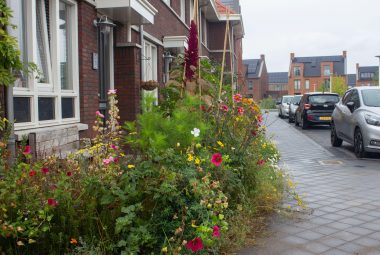
From the park the forest branches into the streets. Edible planting runs along the walking and cycling routes and up to the front edges of the housing blocks. Four districts each take a theme — Fruit, Leaf, Nut and Flower — so the planting changes character across the neighbourhood and every part of Rijnvliet has produce of its own.
Seven layers, 220 species
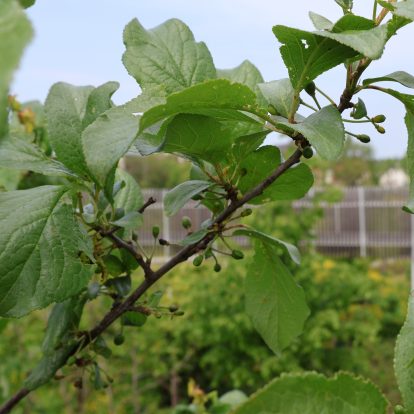
Rijnvliet is organised as a productive ecosystem, built on the principles of food forestry. Apples, pears and currants stand alongside kaki, kiwiberries, olive willows and Lambert walnuts, so something is ripening across most of the year.
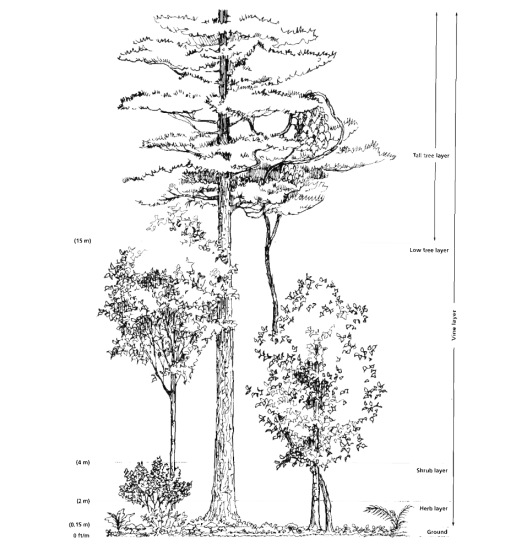
A food forest works in layers, each occupying a different height and a different role. Conventional street planting fills one or two of them. Rijnvliet uses all seven:
- Canopy trees make shade, habitat and a cooler microclimate.
- Low fruit and nut trees carry the seasonal harvests.
- Shrubs produce berries and shelter wildlife.
- Herbs and flowering species feed pollinators.
- Groundcover protects and enriches the soil.
- Root crops open the soil structure and cycle nutrients.
- Climbers add a harvest in the vertical.
The layers shelter one another, feed pollinators, cycle nutrients back into the soil and produce food. Together they hold far more species per square metre than ornamental planting, on less input.
Water as the carrying structure
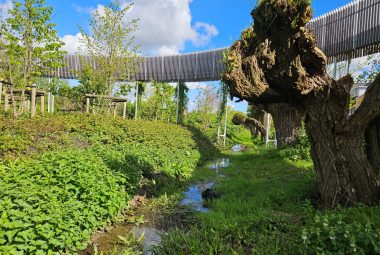
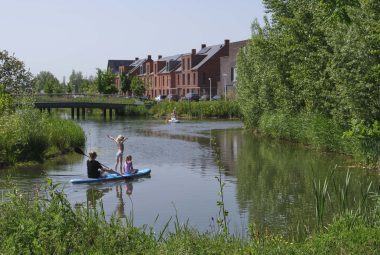
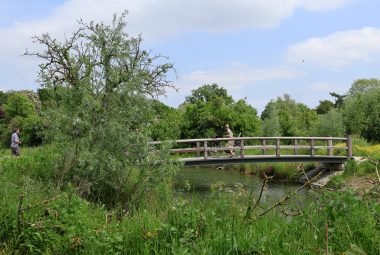
A continuous water structure runs through the neighbourhood. It carries the length of the central park and reaches into each of the districts, so water is present everywhere people live.
Water and soil conditions decide what grows where. Wet edges, infiltration zones and drier ground each support a different community of plants, and the water structure multiplies those conditions across the site. The result is a mosaic of habitats, each with its own species.
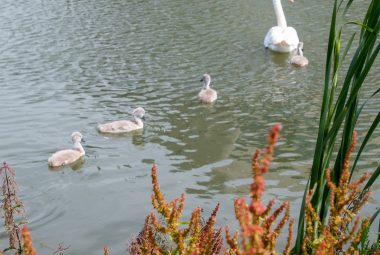
Rainwater infiltrates through the paving. Retention zones hold the excess after heavy rain. An amphibian pool gives aquatic species a breeding ground. A bird island sits undisturbed in the water, reachable only across water, so birds nest without interruption. The structure that keeps the neighbourhood cool and dry underfoot is the same one that carries its wildlife.
Designed, planted and managed together
Participation began before the design and has run through every stage since. Future residents shaped the plan with Felixx, the municipality and Æ Food Forestry Development. Residents and schoolchildren then planted a large part of the forest themselves, tree by tree, which is why so many of them can still point out what they put in the ground.
A second process ran alongside it, inside the municipality. Every maintenance department with a role in the area worked through how a food forest is kept, and a management plan was written around the species richness of the site: what is cut and what is left standing, when, and by whom. A maintenance team was trained for a layered ecology, because a food forest fails under a standard mowing regime.
A food forest asks as much of the maintenance department as of the designer.
The community that runs it
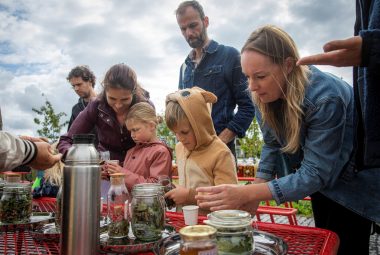
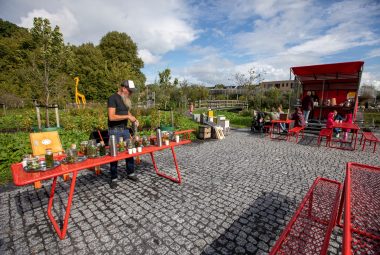
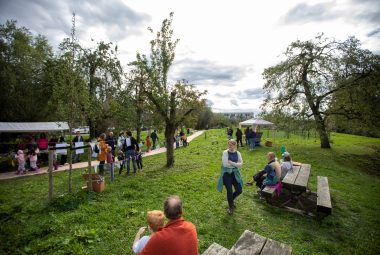
Rijnvliet now has an active community around its forest. Residents maintain parts of it themselves, and they organise what happens there: harvest events, markets, guided tours and courses through the year.
Harvesting is open to everyone. Information boards and a digital tree map record what is planted where and when it ripens. A food forest teacher works in the neighbourhood, and wild foraging courses run for anyone who wants them.
The school uses the forest as an outdoor classroom, where biodiversity, food systems and the turning of the seasons sit a few steps from the door. Many residents have since planted edible species in their own gardens, so the food forest has grown past the boundary drawn for it.
Gaining value as it matures
Felixx designed Rijnvliet to gain value as it matures. The trees grow, the layers close over one another, and the ecological relationships between them thicken. Biodiversity rises with that, and so does the harvest.
The management plan and the trained team are what make that possible. They let the planting develop on its own logic across decades, on a longer horizon than most public green is managed for.


More info
- team
- Felixx
- De Zwarte Hond
- Æ Food Forestry Development
- photography/visuals
- Felixx
- Hedayat Amid
- Jeroen Musch
- Dirk Verwoerd
- awards
- 2026 World Urban Parks Award [winner]
- 2026 IFLA GLA Awards [shortlisted]
- 2026 DNA Paris Design Award [winner]
- 2026 Malaysia Landscape Architecture Awards [winner]
- 2026 Green Good Design Award [winner]
- 2025 Dezeen Awards [winner]
- 2025 City'scape Award [special mention]
- 2023 Dame Sylvia Crowe International [winner]
- 2023 LOOP Design Awards [winner]
- 2023 Landscape institute Award [finalist]
- 2023 WLA Honour Award [winner]
- 2023 A+ Award [finalist]
- 2021 Innovation in Politics Award [winner]
- publications
- MooiNL
- Planur-e
- NRC
- FRAMEweb
- Bomenkaart
- World Landscape Architect
- AD.nl
- CG Concept
- City Deal
- Leidsche Rijn Hogeschool Utrecht
- Leidsche Rijn maken we samen
- Leidsche-Rijn
- Metaal Kathedraal
- RTV Utrecht
- Regio Leidsche Rijn
- Straatbeeld
- Gemeente Utrecht
- Global Design News


